
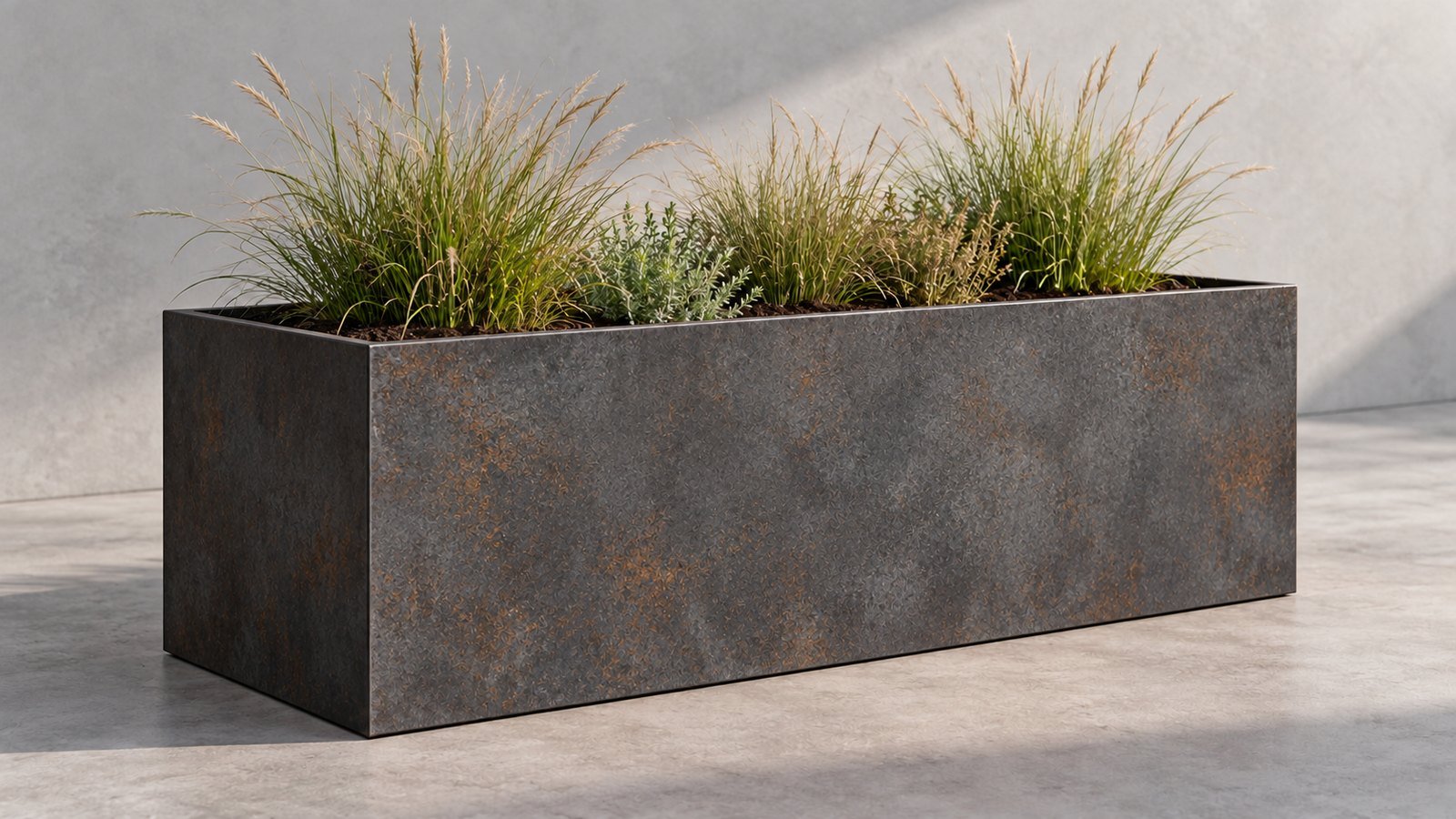
What Are Corten Steel Planters?
Corten steel planters are planting containers fabricated from weathering-steel sheet or plate. They are also described as weathering steel planter boxes, garden troughs and architectural steel planters. Their distinctive orange-brown to darker brown surface develops through atmospheric exposure rather than a painted imitation-rust finish.
The material contains alloying elements that improve resistance to atmospheric corrosion. In suitable exposure, the developing patina helps slow further corrosion. This makes weathering steel attractive for outdoor features where a changing natural surface is part of the design. It is not rust-proof: the exposed faces need opportunities to dry, and the inside of a planter needs its own drainage and moisture-protection details.
Types of Corten Steel Planters
Rectangular Planters and Long Troughs
Rectangular Corten steel planters create a linear planting edge along walkways, terrace boundaries and building entrances. They can hold a repeated planting scheme or divide an outdoor space without a full-height wall. When specifying a long trough, include the clear planting width, soil depth and proposed support positions so the wall panels and base can be assessed together.
Square and Cube Planters
Square planters suit individual shrubs, compact ornamental trees and grouped displays. Their balanced footprint works well beside doorways and at changes in direction within a landscape. Several sizes can be arranged as a coordinated group while retaining a consistent top-edge and finish detail. Select the internal planting volume around the plant’s root system, not only the external appearance.
Round and Cylindrical Planters
Round Corten steel planters soften angular paving layouts and provide a freestanding focal point in courtyards and open entrances. Cylindrical designs are specified by diameter and height; tapered or curved forms also need top and bottom dimensions. The position and appearance of the fabrication seam should be included where the container will be viewed from all sides.
Tall Entrance and Feature Planters
Tall planters provide a strong vertical accent where floor space is limited. They can frame an entrance or add height to a grouped arrangement. The overall height and usable planting depth do not have to be identical; an internal planting insert or supported arrangement can be discussed for the design. Stability, anchorage and the weight of mature planting are particularly important for tall, narrow forms.
Large Tree Planters and Custom Layouts
Large containers are used where a tree or substantial shrub is part of a paved landscape. Root space, irrigation access, base support and lifting arrangements should be resolved before fabrication. Custom corner, stepped or linked configurations can follow an architectural layout. For a combined seating feature, see our Corten steel benches; the planting container and seat structure require coordinated details.
Corten Steel Planter Specifications and Sizes
We quote planters to the dimensions and material requirements of the project. The table below identifies the details used to define a complete planter, from the visible outer form to the concealed base and drainage arrangement.
| Specification | Options and information for quotation |
|---|---|
| Product form | Freestanding planter box, trough, square or round container, tall feature planter, tree planter or drawing-defined configuration. |
| Overall dimensions | Length × width × height, or diameter × height. Give internal dimensions separately where planting volume or an insert must fit. |
| Material | Specified weathering-steel grade and sheet or plate product standard; material certificate requirements included with the enquiry. |
| Wall and base | Thickness, base construction, stiffening and supports to suit container dimensions, planting load and handling. |
| Top edge and corners | Folded return, specified rim or other drawing detail; visible corner and seam treatment. |
| Drainage and internal protection | Outlet positions, clearance below the base, overflow where required, and a suitable liner or internal protection system. |
| Surface appearance | Natural-weathering finish or a requested pre-weathered treatment, with the delivery condition agreed in the offer. |
| Accessories and installation | Feet, supports, anchorage, planting inserts or integrated features identified on the drawing. |
| Order details | Quantity by size, destination, required date, packing and inspection requirements. |
Thickness is selected with the whole container in mind. A long unsupported side, a deep planting volume and a base carried on small feet create different demands from a compact planter resting on continuous support. A standard thickness recommendation without those details can lead to unnecessary weight or insufficient stiffness. Send the proposed wall and base thickness if already designed, or provide the drawing for a quotation review.
Material Grades and Technical Properties
A planter’s material specification should identify more than its rust-coloured appearance. Corten A and other weathering grades have different chemistry, strength and product-form requirements. The selected sheet or plate must match the fabrication and project specification. Our Corten steel plates, sheets and coils page provides the wider flat-product range.
| Material description | How it relates to a planter enquiry |
|---|---|
| Corten A | A weathering-material option for formed architectural components; identify the producer grade and supplied material documentation. |
| ASTM A606 Type 4 | A weathering sheet and strip specification. The material form, rolling condition and ordered edition must match the requirement. |
| EN weathering grades | Specify the full designation, such as S355J0WP, rather than only S355. W and WP grade families have different requirements. |
| Corten B or structural weathering plate | Consider where the approved design calls for that material. Similar appearance does not make different grades interchangeable. |
These descriptions are a selection guide, not an equivalent-grade substitution chart. If the drawing names a grade, retain that designation in the enquiry and have any alternative approved before ordering.
Corten A Chemical Composition Reference
Primary material reference: SSAB COR-TEN A product data (reviewed 13 November 2026). This producer reference is not an ASC stock certificate.
The following example is the published ladle-analysis range for SSAB COR-TEN A hot-rolled material. It provides a grade-specific reference rather than one chemistry for every Corten planter. The mill certificate for the material supplied with the order governs acceptance.
| Element | Mass percentage |
|---|---|
| Carbon C | 0.12 maximum |
| Silicon Si | 0.25–0.75 |
| Manganese Mn | 0.20–0.50 |
| Phosphorus P | 0.07–0.15 |
| Sulfur S | 0.030 maximum |
| Aluminium Al | 0.015–0.06 |
| Copper Cu | 0.25–0.55 |
| Chromium Cr | 0.50–1.25 |
| Nickel Ni | 0.65 maximum |
Corten A Mechanical Properties Reference
| Property | Published minimum |
|---|---|
| Yield strength | 345 MPa |
| Tensile strength | 485 MPa |
| Elongation A50 | 20% |
Source: SSAB COR-TEN A hot-rolled product data, checked 27 October 2026; published hot-rolled product thickness range 2.00–12.70 mm, with properties tested transverse to rolling. This is the reference material’s range, not a planter wall-thickness recommendation. These base-material values are not a load rating for the finished planter. Container stiffness and load capacity also depend on its dimensions, thickness, welds and supports.
Fabrication Details That Shape the Finished Planter
Planters are generally made by cutting weathering-steel sheet or plate, forming the sides and joining the assembly to the specified base or supports. The design determines which faces are folded and where welded joints are needed. A folded return can create a defined top edge, while corner and seam details influence both appearance and cleaning access.
For architectural work, mark the visible faces on the drawing and state the desired weld appearance. Large flat sides may need internal stiffening, and complex shapes may be easier to transport as coordinated sections. Drainage openings and support details should be incorporated before surface preparation. We quote the finished configuration and accessories against the agreed drawing rather than leaving these details to the installation stage.
Drainage and Internal Protection
Drainage is a functional part of the planter, not simply a hole added after fabrication. Rain and irrigation water need a clear route out, with outlets positioned so growing medium does not obstruct them. The planting design should also provide access for checking and clearing the drainage arrangement.
The exterior and interior experience different conditions. The outside may dry between periods of rain, while soil against the inside can remain damp. A suitable liner or internal protection system can separate those conditions, provided its outlets and junctions do not trap water against the steel. Agree the liner material, drainage route and any overflow as one detail. For an open-bottom planting area rather than a self-contained planter, explore our Corten steel raised garden beds.
Natural Patina and Surface Finish
The warm, textured finish is a major reason architects choose Corten steel garden planters. It complements planting and contrasts with pale paving, timber and contemporary building materials. Natural weathering also means the final colour is not a uniform coating: exposure, orientation and shelter affect how individual faces develop.
Specify whether you want the planter delivered for natural weathering or with a pre-weathered treatment. Agree the appearance using an appropriate sample where consistency matters. Allow for run-off staining in the landscape detail, especially beside light stone or concrete. Drainage should discharge away from sensitive finishes, and the outer walls should not remain buried in wet soil. Coastal spray, de-icing salts and persistently damp locations need a separate suitability assessment.
Industries and Landscape Applications
| Buyer or project sector | Typical application and purchasing focus |
|---|---|
| Landscape contractors | Coordinated planter schedules for courtyards, paths and planted boundaries; repeat dimensions, drainage and installation access. |
| Architects and property developers | Entrance features and exterior landscape elements; proportions, visible seams, finish and compatibility with adjacent materials. |
| Hotels and hospitality projects | Terrace divisions, restaurant frontage and outdoor guest areas; safe circulation, cleaning access and planting maintenance. |
| Commercial offices and retail developments | Forecourt greenery and focal planting; consistent appearance across grouped units and practical servicing. |
| Public spaces and institutional campuses | Tree or shrub containers in hard landscaping; robust supports, anchorage and the project’s inspection requirements. |
| Residential landscape projects | Garden and courtyard planting, including coordinated troughs and individual containers. Roof and balcony installations require structural approval. |
For a wider landscape package, Corten steel garden edging can define the ground-level border, while privacy screens provide a separate vertical feature. Coordinating these components by drawing helps align the material, proportions and intended weathered appearance across the project.
Inspection, Documentation, Packing and Export Supply
Amardeep Steel Centre LLP welcomes domestic and international planter enquiries from contractors, importers and distributors, including buyers in the USA, UK, Europe, Canada and Brazil. Send the delivery destination with the schedule so packing, transport dimensions and unloading requirements can be considered alongside the product.
Specify material certificates and any inspection requirements at the enquiry stage. Relevant checks can include overall dimensions, wall and base thickness, accessible edges, visible weld finish, drain positions and the agreed delivery surface. For a multi-size order, identify each planter by a drawing or item number so the quotation, packing list and installation schedule can be matched.
Packing should protect visible faces and edges while keeping the load stable during handling. Large units may need individual crating or a project-specific arrangement; nesting should be agreed only where the geometry and finish allow it. Plan lifting and positioning before the containers are filled. Availability, fabrication time and the delivery schedule are confirmed with the quotation.
Planter quotation comparison
Separate the decorative outer planter, any liner, drainage components and supports into quoted items. Ask the supplier to identify which drawing revision and material document the price covers, and which site work is excluded. Compare delivered scope rather than comparing only external dimensions: a visually similar shell may leave drainage, anchorage or handling requirements unresolved.
For the exposure information to attach to your planting schedule, use the weathering-steel exposure and RFQ checklist.
Corten Steel Planter FAQs
What is the difference between Corten steel and ordinary rusty mild steel?
Weathering steel is alloyed for improved atmospheric-corrosion resistance. An ordinary steel container does not acquire the same material specification simply because it develops a rust-coloured surface. Specify the grade and request the relevant material documents rather than selecting only by appearance.
Can I order custom Corten steel planter sizes?
Yes. Send the overall dimensions, quantity and a sketch or drawing. Include the internal planting depth, top-edge detail and any base, liner or support requirements. This gives us a clear basis for quoting the complete configuration.
Which planter shape should I choose?
Long troughs suit linear planting, square containers work well in grouped arrangements, and round planters create individual focal points. Planting volume and access for maintenance matter as much as the external shape. Tall designs also need attention to stability and anchorage.
How thick should a Corten steel planter be?
There is no single thickness for every planter. The required wall and base depend on its dimensions, wet planting load, stiffening, support points and handling method. Include the proposed thickness in your drawing or send the design details for review.
Do Corten planters need a liner and drainage?
The container needs a drainage arrangement suited to the planting and installation. A liner or other internal protection may be used to separate damp growing medium from the steel, but it must be detailed with the outlets so water cannot become trapped behind it.
Are the planters supplied pre-weathered?
The delivery finish is agreed with the order. Tell us whether you want natural weathering after installation or a pre-weathered appearance. The colour can continue to change outdoors, and a finish sample is useful when appearance is critical.
Will a Corten planter stain the paving?
Weathering run-off can mark nearby surfaces, particularly light-coloured porous finishes. Include drainage, separation and cleaning access in the landscape design. A pre-weathered appearance should not be treated as a guarantee of stain-free run-off.
Can these planters be used on rooftops or balconies?
Only after the supporting structure and installation have been checked. The assessment must include the container, wet growing medium, retained water and mature planting, together with stability and wind exposure. Arrange unloading and placement before filling.
Are Corten steel planters suitable for coastal sites?
Salt exposure and persistent wetness can interfere with protective weathering. Describe the actual location, including sea spray or de-icing salt exposure, so the designer can assess whether bare weathering steel is suitable or a different material or protective system is needed.
What determines the planter price and delivery time?
Dimensions, material, thickness, quantity, forming and welding, surface treatment, accessories, inspection and packing all affect the quotation. Share the destination and required delivery date early, particularly for oversized or coordinated project orders.
Request a Corten Steel Planter Quotation
Send your planter schedule to Amardeep Steel Centre LLP with dimensions or drawings, quantity, material grade if specified, finish, drainage and liner details, and delivery destination. Highlight any matching landscape components so they can be considered together.
Email deepak@amardeepsteelllp.com or call +91-8591210578. You can also use the enquiry form below to describe your project and request a quotation.