
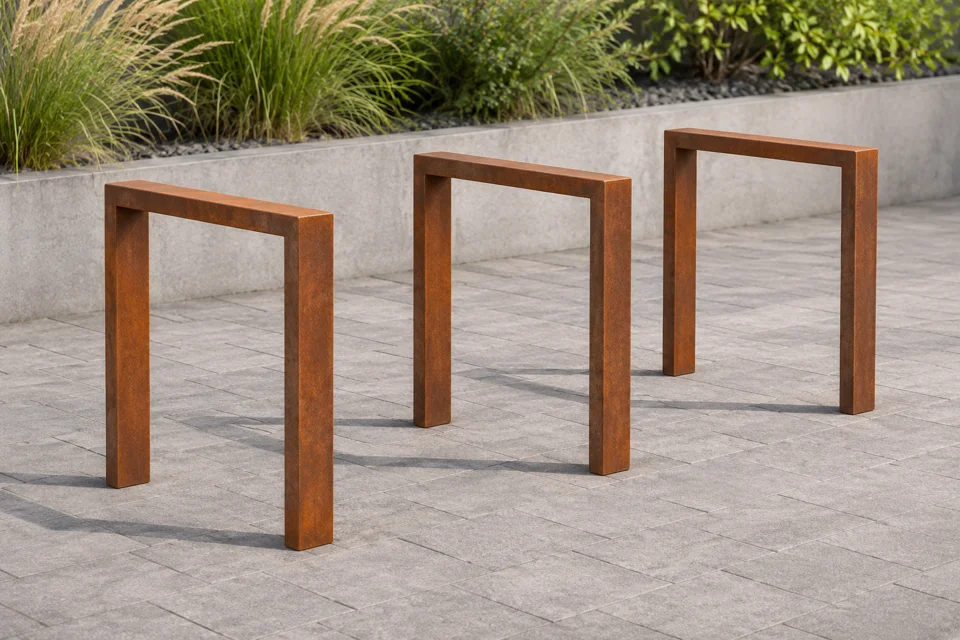
Corten Bike Racks for Practical Cycle Parking
Corten steel bike racks combine a weathering-metal appearance with a defined place to support and lock bicycles. They can complement a landscape scheme without looking like an unrelated piece of street equipment. The rack still needs to work for the bicycle: a clear locking point, useful frame support and adequate space around the parked cycle are more important than a sculptural outline alone.
Amardeep Steel Centre LLP supplies Corten cycle-rack configurations for architects, landscape contractors, property developers and importers. Enquiries can cover individual stands or coordinated groups for a site. Provide the intended bicycle types and layout so the rack geometry and number of genuinely usable parking positions can be reviewed together.
Bike Rack Types and Layouts
Inverted-U and Hoop-Style Stands
An inverted-U or hoop-style stand can provide a simple, recognizable parking point. The shape should allow a bicycle frame to rest securely and give users a practical route for a lock. The contact points and section dimensions must be compatible with common bicycle frames and locks rather than chosen only to match the surrounding metalwork.
Plate-Form Architectural Racks
A cut or folded plate form offers a more distinctive silhouette for a designed landscape. Openings can create locking points, but their size and position should remain usable when a bicycle is parked. Avoid a purely decorative cut-out that leaves the frame unsupported or forces the user to lock only a wheel. Exposed edges at contact and locking areas need careful treatment.
Grouped and Repeated Parking Stands
A repeated rack layout can serve offices, retail destinations or campuses. The distance between stands and nearby obstacles affects how many cycles can actually be parked. Show the complete bicycle envelope on the site plan, including handlebars and access for locking, rather than counting every visible loop as an independent space.
Drawing-Defined and Coordinated Street-Furniture Designs
Custom rack forms can share a material palette with other landscape products. Keep the functional requirements visible in the design brief: support, locking, access and anchorage. Coordinate the appearance with Corten benches and litter bins, but evaluate the bike rack as a working parking facility in its own right.
Bike Rack Specifications and Site Dimensions
A rack schedule should distinguish the product size from the space required for a parked bicycle and its user. Both are needed to design a usable installation.
| Specification | Information for the enquiry |
|---|---|
| Rack form | Hoop, plate-form or other drawing-defined cycle stand. |
| Bicycle compatibility | Expected conventional, cargo or other cycle types and relevant frame/contact requirements. |
| Locking arrangement | Accessible frame-and-wheel locking positions suited to the intended locks. |
| Dimensions | Overall rack height, width, section or plate dimensions and usable openings. |
| Layout | Number of stands, spacing, orientation and adjacent walls, furniture or planting. |
| Fixing | Surface-mounted or embedded arrangement, substrate and anchorage design. |
| Material and finish | Weathering-steel grade, accessible edge detail and delivery appearance. |
| Procurement | Quantity, inspection criteria, packing and destination. |
Frame Support and Locking Function
A useful rack supports the bicycle without depending solely on a narrow wheel slot. Its geometry should allow the frame and at least one wheel to be secured with an appropriate lock. Test the proposed arrangement against the bicycles expected at the site, because unusual frames, wide tyres and accessories can change the space and contact requirements.
Parking should be intuitive. A design that needs lengthy instructions or requires users to lift a heavy cycle may be unsuitable for an everyday short-stay location. The apparent number of positions should be checked with bicycles in place, not inferred from the number of decorative openings.
Material, Construction and Anchoring
Corten plate or selected sections can form the rack, depending on the drawing. Identify the grade and dimensions required for the design, with relevant material documents where specified. Related flat bar and weathering-steel plate can be considered as raw-product options; the finished rack construction must still be designed for its purpose.
Anchorage is part of the parking system. The base connection and supporting construction should resist the intended service conditions and remain accessible for inspection where required. Tamper-resistant details may be specified for exposed locations, but no steel rack should be presented as theft-proof. Any security rating must be supported for the actual product and installation.
Placement and Real Parking Capacity
Locate cycle parking where users can find it and approach it without obstructing the main pedestrian route. A stand that looks tidy when empty may block a path when occupied. The site plan should account for the entire parked bicycle, access to the lock and movement around neighboring cycles.
Offices and campuses may need a combination of short-stay visitor parking and other facilities for regular users. Retail and hospitality sites often prioritize proximity to the entrance and clear visibility. Describe the use pattern in the enquiry so the rack schedule is based on practical demand rather than an arbitrary row of identical pieces.
Applications and Landscape Integration
Corten bike racks can form part of commercial forecourts, institutional campuses, residential common areas and public-realm schemes. Their appearance can complement planters and architectural features while retaining a clearly identifiable parking function. In public installations, the responsible designer should check local requirements and permissions for the location.
For landscape contractors, a coordinated schedule can simplify procurement of rack, seating and waste-bin metalwork. Keep each item’s drawings and requirements separate, even where the finish is shared. This helps prevent a decorative furniture specification from being used as a substitute for a functional cycle-parking design.
Finish, Contact Areas and Maintenance
Natural weathering can change the surface texture and colour over time. Consider the areas where bicycles and users touch the rack, and specify any protective or alternative contact detail where the project requires it. A weathered finish should not conceal sharp edges or rough fabrication at locking points.
Plan drainage at the base and inspect fixings and contact surfaces as part of routine maintenance. Run-off may affect adjacent paving, particularly during early weathering. If a pre-weathered appearance is requested, agree the finish and its limits before delivery rather than assuming it behaves like a sealed coating.
Inspection, Packing and Supply
Procurement checks can include overall dimensions, locking openings, accessible edges, base-hole positions, visible welds and the intended finish. For a custom design, a prototype or fit review may be appropriate before a large order. State any required design verification or security testing in the enquiry.
Packing should protect the contact and locking areas and keep repeated stands aligned during transport. Provide the quantity, destination and installation sequence so batches can be identified appropriately. Amardeep quotes domestic and export project requirements with the agreed metalwork, accessories and documentation clearly itemized.
Frequently Asked Questions
Does a decorative Corten shape automatically make a good bike rack?
No. The design must support the bicycle and provide practical locking positions. Review the geometry with the intended bicycle types rather than selecting only by appearance.
Can you quote inverted-U or hoop-style racks?
Send the preferred dimensions, section details and fixing arrangement. The offer should identify the material, construction and quantity for the actual design.
How many bicycles can a rack hold?
Usable capacity depends on geometry, spacing and the bicycles being parked. Confirm it through the layout rather than assuming each loop or opening provides an independent position.
Are the racks theft-proof?
Appropriate locking geometry, anchorage and site visibility support cycle security, but no rack can eliminate theft risk. Request evidence for any tested security rating required by the project.
Can the racks be fixed to existing paving?
The supporting construction and anchor arrangement need review. Provide substrate information and the intended location so the fixing detail can be specified correctly.
Will Corten steel mark bicycle frames?
Unsealed weathering surfaces can transfer rust residue at contact points. Assess the finish and any protective contact detail against the intended bicycle frames while preserving usable locking and support geometry.
Can racks accommodate cargo bikes or unusual frames?
Provide the expected cycle types and dimensions. A standard-looking rack may not offer suitable space or contact points for every bicycle, so compatibility should be checked.
What is needed for a project quotation?
Send the rack drawing, layout, quantity, bicycle requirements, fixing details, finish, destination and inspection criteria. This gives a clear basis for quoting usable cycle-parking equipment.
Request a Corten Bike Rack Quotation
Use our enquiry form to send your cycle-parking layout and rack specification. Contact Amardeep Steel Centre LLP at deepak@amardeepsteelllp.com or +91-8591210578.