
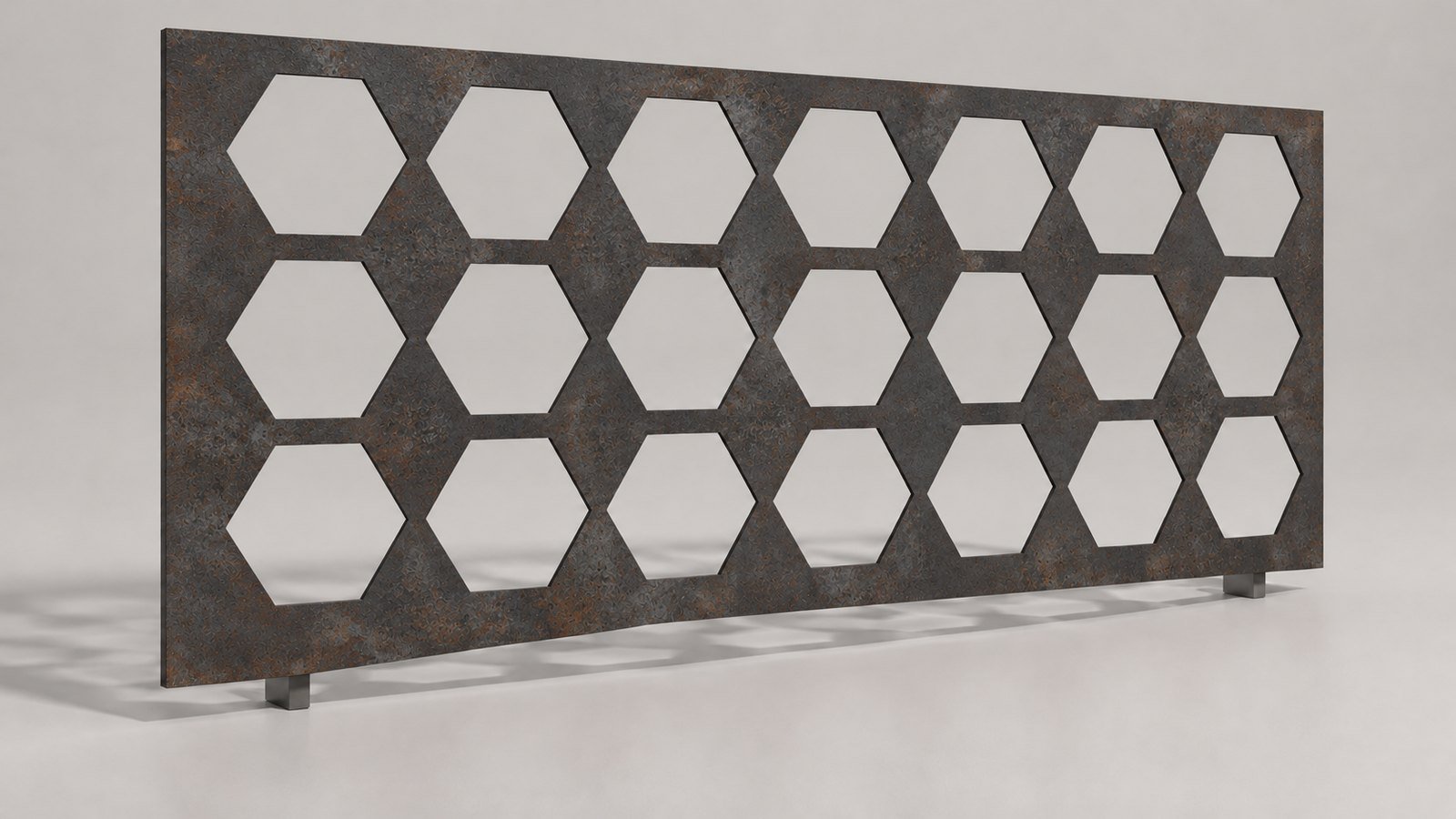
Laser-Cut Corten Sheets for Decorative and Fabricated Components
Corten steel laser-cut sheets are weathering-steel blanks or panels cut to a defined outline and pattern. The process can produce decorative openings, lettering, fixing holes and shaped components from approved digital artwork. The result may be a finished visible panel or a part that will be folded, framed or assembled by the project fabricator.
Amardeep Steel Centre LLP supplies laser-cut Corten sheets and panels for architectural metalwork, landscape projects, sign contractors and importers. We quote the specified material, thickness, drawing and finishing requirements together. For unprocessed material, see our Corten steel plates and sheets; a cut-component enquiry needs the additional geometry and acceptance details described below.
Laser-Cut Sheet and Panel Types
Decorative Pattern Panels
Repeated geometric or bespoke patterns turn a sheet into a light-filtering architectural element. The design should balance appearance with enough connected material to handle and support the panel. A continuous border may be useful for framing or fixing. Pattern alignment across several panels should be indicated in the artwork, especially where the design repeats over a large surface.
Screen and Facade Blanks
Cut blanks can be prepared for a screen frame, folded cassette or other defined assembly. Show the finished outline and all holes, but also identify any later folds or welds that influence the cutting layout. The cutting file should not confuse bend lines or notes with features to be cut. Related Corten privacy screens and facade panels cover the complete component context.
Lettering, Numbers and Logo Panels
Laser cutting can form a message through a sheet or create separate letters. Internal islands and fine strokes need practical connection or mounting details. The final artwork should be checked for spelling, orientation and scale before approval. Our Corten signage page addresses the viewing, contrast and installation requirements beyond the cutting operation.
Profiled Blanks and Fabrication Parts
Shaped plates, brackets, infill pieces and other blanks can be cut from a dimensioned drawing for subsequent assembly. Critical dimensions and hole tolerances should be identified rather than applying an unspecified tolerance to every edge. Where a part will be welded or bent, include the material grade and later process requirements so the blank is suitable for the intended route.
Garden and Artistic Components
Decorative outlines can be incorporated into landscape features or sculptural assemblies. The complete design determines the supports, edges and safe public interface. A cut shape is not automatically a freestanding structure. For finished feature enquiries, see Corten sculptures and garden art.
Drawing, Material and Size Specification
| Item | Information needed |
|---|---|
| Material | Exact weathering-steel grade, product form and requested certificate. |
| Thickness | Specified nominal thickness and relevant acceptance tolerance. |
| Blank size | Overall dimensions, finished outline and any grain/rolling direction requirement. |
| Digital file | Scaled vector geometry with cut paths separated from text and notes. |
| Pattern | Openings, minimum remaining features, borders and orientation. |
| Critical features | Hole sizes, positional tolerances, fit-up dimensions and datums. |
| Secondary work | Deburring, forming, welding, framing or other operations included in scope. |
| Surface | Visible face, delivery finish and acceptable handling or process marks. |
| Quantity | Parts by drawing revision, identification and packing arrangement. |
Use a clear drawing revision and consistent units. If a DXF or other vector file accompanies a dimensioned PDF, they should describe the same geometry. Mark which document controls if there is a discrepancy, and resolve it before cutting. For multiple components nested from one sheet, identify each part separately so quantities and markings can be checked.
Corten Grade Selection and Material Properties
Laser cutting does not change one grade into another. The starting sheet or plate must meet the ordered material specification, and its properties remain relevant to later forming, welding and use. Corten A, ASTM weathering sheet and structural weathering plate are separate specifications with their own requirements. An alternative needs technical approval, not just a similar colour.
Our Corten A sheet range provides a related material route. The following reference illustrates one precisely identified grade. It is useful for comparing a drawing requirement with supplier documentation, not as a universal chemistry for every cut panel.
Named Corten A Material Reference
Primary material reference: SSAB COR-TEN A product data (reviewed 13 November 2026). This producer reference is not an ASC stock certificate.
| Element | SSAB COR-TEN A hot-rolled ladle-analysis mass % |
|---|---|
| Carbon | ≤0.12 |
| Silicon | 0.25–0.75 |
| Manganese | 0.20–0.50 |
| Phosphorus | 0.07–0.15 |
| Sulfur | ≤0.030 |
| Aluminium | 0.015–0.06 |
| Copper | 0.25–0.55 |
| Chromium | 0.50–1.25 |
| Nickel | ≤0.65 |
| Property | Published minimum |
|---|---|
| Yield strength | 345 MPa |
| Tensile strength | 485 MPa |
| Elongation A50 | 20% |
This reference applies to the named producer’s hot-rolled 2.00–12.70 mm material scope, with mechanical tests transverse to rolling. It is not an ASC laser-cutting thickness range. The actual material certificate and agreed cutting capability govern the order, while the finished component’s design is assessed separately.
Cut Edges, Tolerances and Fine Features
A cutting specification should define the edges and dimensions that matter to the application. A decorative panel viewed at a distance and a part that must fit a close assembly can need different acceptance criteria. Identify burr removal, edge finishing and any visible face restrictions in the enquiry.
Narrow bridges, small holes and closely spaced features need review in relation to material thickness and the proposed process. Heat introduced during cutting can affect local geometry and edge condition. The fabricator should confirm achievable features and tolerances for the actual drawing rather than relying on a universal precision claim. Where later welding or bending is planned, coordinate the edge preparation and bend zones before cutting.
From Digital Artwork to a Usable Panel
A useful production drawing combines appearance with practical assembly information. It shows how the panel will be supported, where fasteners sit and which edges remain visible. The design may need a solid perimeter, folded returns or a frame to carry the pattern. Those decisions should be made before the final cutting file is released.
For a repeated architectural pattern, include panel numbers and alignment references. A trial piece or representative sample can be useful when fine detail, finish or fit is important; include that requirement in the enquiry. Sample approval should be tied to the same material and drawing revision intended for the main order.
Surface Finish and Weathering
The cut component can be supplied in the agreed delivery condition for natural weathering or a specified surface treatment. The exposed faces and cut edges may not begin with an identical appearance. If initial colour is important, define the required treatment and review a representative sample.
Weathering depends on the installed exposure. Details should permit drainage and avoid persistent wet contact at concealed interfaces. Consider where run-off will go, particularly when a patterned panel is positioned above light paving or against sensitive finishes. Cutting a pattern does not remove the need to design the panel’s mounting and moisture management.
Industries and Applications
| Buyer or application | Typical requirement |
|---|---|
| Architectural metalwork | Patterned facade blanks, folded-panel blanks and coordinated fixing holes. |
| Landscape contractors | Decorative screens, garden features and shaped component sets. |
| Sign contractors | Lettering, logos and stencil-cut sign panels with approved artwork. |
| Fabricators and project importers | Drawing-defined parts for later forming or assembly, with material traceability. |
For an integrated project, combine the cutting schedule with the finished-component drawings. This avoids quoting a decorative pattern without the holes, borders or secondary work needed to make it usable on site.
Inspection, Traceability and Export Packing
Inspection can cover material identity, thickness, part count, drawing revision, critical dimensions, cut edges and visible finish. Specify required certificates and any agreed sample or inspection stage before the order is finalised. The packing list should identify different parts so the receiving team can reconcile them with the drawing schedule.
Flat sheets and delicate patterned panels need support during transport to prevent bending. Separate visible faces and protect narrow features without trapping moisture against the surface. For export quotations, provide the destination, package-size restrictions and whether components must be grouped by installation zone. Availability, processing scope and delivery timing are confirmed in the offer.
Artwork-to-order acceptance checklist
Identify the approved artwork filename and revision in the order, together with the visible face, units and panel orientation. Keep pattern approval separate from material approval: accepting a cut-pattern sample does not approve a substitute grade. Before quoting repeat panels, resolve which dimensions control overall fit and which describe the decorative openings, then agree the inspection record for the finished pieces.
For a cut panel that becomes a wall element, review the separate cladding-panel fixing and system-scope requirements.
Frequently Asked Questions
Can you cut my own design?
Yes, send approved vector geometry with dimensions, thickness and quantity. Fine features and connected material must be reviewed before the design is released for cutting.
Which file format should I provide?
A scaled vector cutting file with a dimensioned reference drawing is a useful starting point. Confirm the accepted format during quotation and ensure both files use the same revision and units.
Can you work from a raster image?
An image can explain the visual intention but usually needs conversion into approved cut geometry. Do not assume a photograph or low-resolution logo is a fabrication-ready file.
What thicknesses can be laser cut?
State the required grade and thickness with the drawing. Achievable cutting scope is confirmed for the actual geometry and process rather than presented as an unverified universal range.
Are small holes and fine patterns possible?
Their feasibility depends on thickness, spacing and the remaining material. The drawing should be reviewed for edge quality, distortion and practical handling.
Can panels be folded after cutting?
They can be specified for secondary forming, but bend lines, material direction and cut features near folds need coordination. Include the finished geometry in the enquiry.
Are the cut edges deburred?
Specify the required edge finish, particularly for accessible or visible parts. The quotation should identify deburring or other finishing rather than leaving the acceptance standard unclear.
Will the pattern change panel strength?
Yes, removing material changes stiffness and load paths. The finished panel, supports and connections must be designed for its actual function.
Can you supply certificates with cut parts?
State the required material documentation and traceability in the enquiry. Part identification should preserve the agreed link to the supplied material.
What affects the price?
Material, thickness, number of parts, cutting complexity, secondary operations, finish, inspection and packing all affect the quotation. Provide the complete drawing schedule for a useful comparison.
Request a Laser-Cut Corten Sheet Quotation
Send the approved cutting files, reference drawings, grade, thickness, quantity and destination through our laser-cut sheet enquiry form. Identify secondary work and visible-face requirements so the offer covers the finished parts you need.