
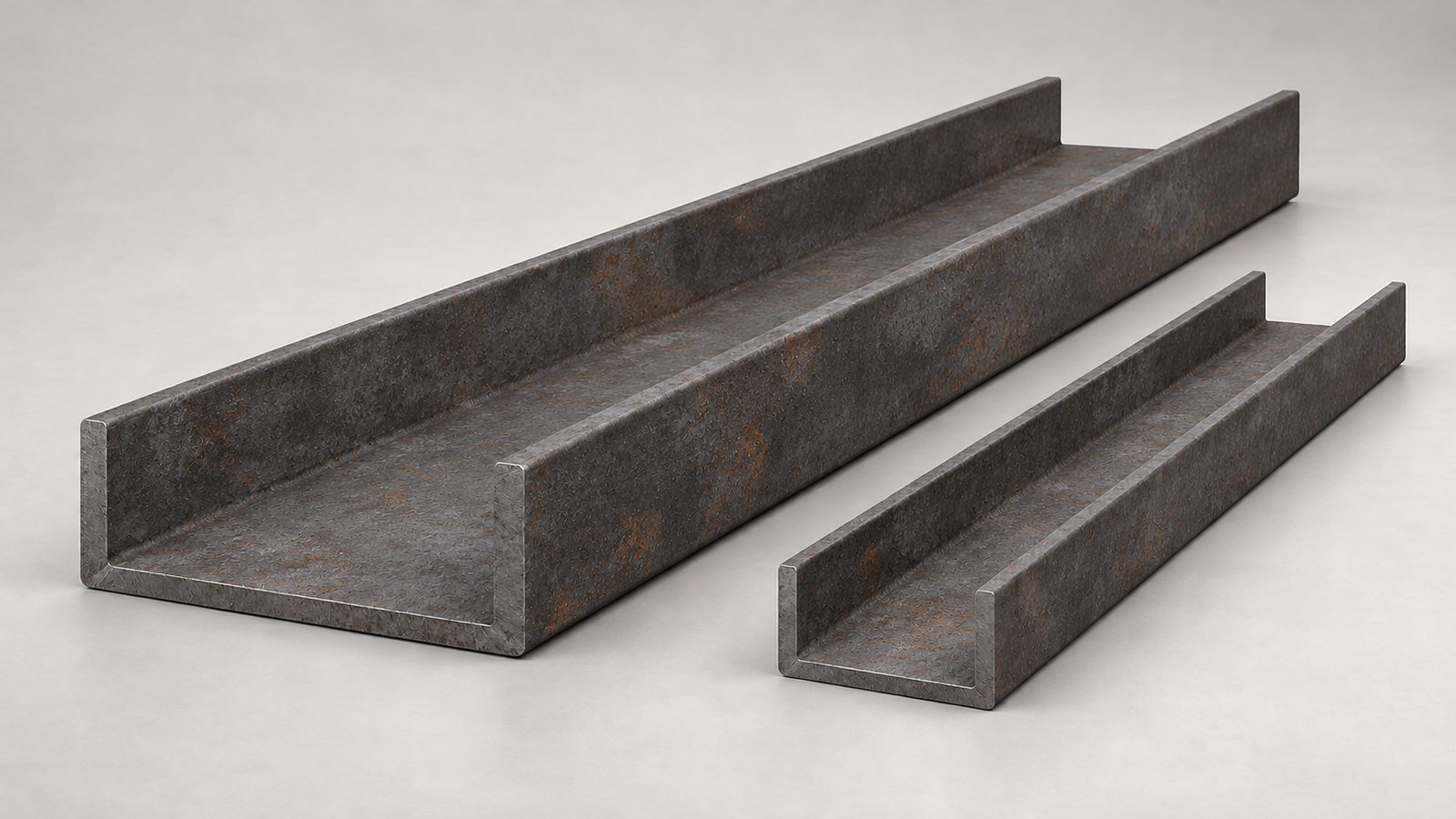
Corten Steel Channels for Frames, Supports and Fabricated Details
Amardeep Steel Centre LLP supplies Corten steel channels for fabricators, construction contractors and architectural steelwork. A channel combines a web with two flanges projecting to one side, creating an open section that is convenient for many framing and attachment details. Weathering-steel channels can form part of an exposed assembly where the material grade and site conditions suit the project.
The open profile provides access to the inside face for connections, while its web offers a useful surface for bolted or welded attachments. These features make the channel different from a closed tube or a symmetrical I-shaped member. Selecting the right section involves its geometry, orientation and connection arrangement, not simply choosing a depth that fits the available space.
Use our channel supply enquiry form to send the exact designation or drawing, lengths, quantity and grade. Include any holes, end cuts or other processing in the same schedule.
Channel Types and Cross-Section Details
Rolled Structural Channels
A rolled channel is identified by its recognised section series and size. Different series have different flange widths, thicknesses and radii, and some use tapered rather than parallel flange faces. Keep the complete designation from the drawing, including mass per length where it is part of the naming system. This helps identify the actual section rather than a visually similar alternative.
Parallel-Flange and Tapered-Flange Geometry
Flange geometry affects how a bolt, washer or connecting plate seats against the section. It also changes the clearance available near the web-to-flange radius. For a channel that must fit around another component or receive a plate inside its opening, include the clear internal dimensions and required contact faces. An outside width measurement alone may not describe the fit.
Formed or Drawing-Defined Channels
A channel can also be formed from suitable flat material or built to a particular drawing. Such a product may have a different corner shape, thickness distribution and tolerance basis from a rolled section. Specify this route when it is intended, and identify the bend radii and finished dimensions. A formed channel should be evaluated as the actual product offered, not assumed equivalent to a standard rolled size.
Channel Sizes and Ordering Specification
| Parameter | Details for quotation |
|---|---|
| Section identity | Exact rolled designation or a cross-section drawing. |
| Cross-section dimensions | Overall depth, flange width, web and flange thickness, and relevant radii. |
| Orientation | Open side direction, installed axes and attachment faces. |
| Length and quantity | Piece schedule, length tolerance and item references. |
| Material | Weathering grade, standard edition, delivery condition and required documents. |
| Processing | Hole pattern, end cuts, slots, attachments and inspection requirements. |
For a fabricated frame, include both the raw channel schedule and any processing drawings. Show the open side on the assembly drawing, because rotating a channel changes access to its connections and can change the way the member responds to loading. If an existing structure is being extended, provide the original section details or measured geometry so the proposed supply can be checked for compatibility.
Open-Section Behaviour and Connection Layout
Unlike a doubly symmetrical section, a channel’s open shape means the position of the applied load relative to the section matters. Eccentric attachments and unrestrained loading can introduce twisting as well as bending. The engineer should assess the complete arrangement, including restraints and connections, rather than relying only on the depth or nominal weight.
Two channels can be combined in a designed assembly, but the spacing and connections between them determine how they act together. They are not automatically a replacement for an I beam or H beam. Where a pair is specified, include the assembly drawing, stitch or connector details and inspection requirements.
Material Grade, Chemistry and Mechanical Properties
The section shape and the steel grade are separate choices. For channels, a project may specify ASTM A588 Grade B or an appropriate EN weathering grade, together with the product dimensions and delivery requirements. The material documents must identify the ordered grade; an ordinary carbon-steel section does not become weathering steel simply by developing a brown surface.
The following reference summarises A588 Grade B structural-shape data in the ArcelorMittal 2023 sales programme, published against ASTM A588/A588M-19. Its listed supply scope is nominal thickness up to 63 mm. It is a material reference, not Amardeep stock availability; use the edition and certificate required by the purchase order.
| Element | Heat-analysis reference, mass % |
|---|---|
| Carbon C | 0.20 maximum |
| Manganese Mn | 0.75–1.35 |
| Silicon Si | 0.15–0.50 |
| Sulfur S | 0.05 maximum for structural shapes |
| Phosphorus P | 0.04 maximum for structural shapes |
| Copper Cu | 0.20–0.40 |
| Nickel Ni | 0.50 maximum |
| Chromium Cr | 0.40–0.70 |
| Vanadium V | 0.01–0.10 |
| Property | Structural-shape reference |
|---|---|
| Yield strength | 345 MPa minimum |
| Tensile strength | 485 MPa minimum |
| Elongation, 200 mm gauge length | 18% minimum, subject to A6/A6M adjustments |
| Elongation, 50 mm gauge length | 21% minimum within the producer’s stated thickness scope, subject to A6/A6M adjustments |
The producer table also specifies a maximum carbon equivalent of 0.47% for flange thickness above 50 mm; the full standard’s chemistry provisions apply. Impact toughness, if required, must be ordered explicitly. Material strength does not establish the capacity of a member without its section geometry, restraint and connection design.
| Related designation | How to compare it |
|---|---|
| ASTM A588 Grade B | A defined structural material grade; retain its ordered standard and edition. |
| S355J0W / S355J2W | EN weathering grades with distinct toughness designations and thickness-dependent requirements. |
| Corten B | A commercial weathering-material designation; confirm the actual producer specification and product form. |
Our ASTM A588 material page and S355J2W material information provide related grade context. Those flat-product pages are useful for separately ordered connection plates, but they do not replace the documentation for the section itself. Similar strength or weathered colour is not proof of automatic grade equivalence.
Cutting, Drilling and Workshop Preparation
Channels are often purchased as part of a fabrication schedule with repeated cut lengths and hole patterns. Identify the datum for holes and the direction of any angled cut. A clearly marked open side avoids confusion when left-hand and right-hand components are required. Where a connection bears on a flange face, include the necessary seating detail rather than leaving it to site adjustment.
Welding and thermal processing should follow procedures suitable for the ordered material and thickness. Include any requirements for visible weld appearance, edge preparation and dimensional examination. The inspection scope can cover section identification, straightness, length, hole position, cut accuracy and traceability, with weld examinations specified where additional fabrication is included.
Industries and Channel Applications
| Application area | Typical role and purchasing focus |
|---|---|
| General structural fabrication | Designed frames and secondary members; exact section and connection orientation. |
| Architectural supports | Exposed subframes and attachment details; visible faces, edge treatment and weathering coordination. |
| Industrial assemblies | Drawing-defined equipment supports and frames; eccentric loads, restraints and access for maintenance. |
| Landscape steelwork | Specified support or edging details; drainage, ground contact and the intended duty. |
A channel used as a structural member should not be confused with a simple decorative border. Soil pressure, retained water or contact with permanently wet ground introduces different design and corrosion considerations. For a landscaping-only requirement, compare the purpose with our Corten steel garden edging rather than specifying a structural section by habit.
Weathering and Open-Channel Drainage
An upward-facing channel can collect water and debris unless the design provides a suitable drainage route. Orientation is therefore relevant to both structural behaviour and corrosion performance. Keep water from being trapped behind attachments, and ensure that areas expected to weather naturally have an opportunity to dry. Sheltered damp surfaces may behave differently from exposed faces.
Assess sea spray, de-icing salt and other chloride contamination before selecting bare weathering steel. Plan run-off away from light paving and finishes, particularly during initial exposure. Where a coating or other protection is specified for particular contact areas, include that requirement in the supply scope and installation details.
Documentation, Packing and Delivery
Request the required material certificate and inspection records before ordering. Maintain the connection between heat or batch identification and cut items where traceability is important. Associated Corten steel angles and flat bars can be scheduled alongside channels for a coordinated fabrication order, each with its own dimensions and grade requirements.
For domestic and international deliveries, provide the destination, required sequence and unloading restrictions. Bundles should remain stable and protect processed ends and holes from handling damage. The offer confirms current availability, processing and lead time for the section and quantity requested, rather than applying one delivery promise to every size.
Frequently Asked Questions
What is the difference between a channel and a rectangular tube?
A channel is open on one side; a rectangular tube has a closed perimeter. Their connection access, torsional behaviour and drainage details differ, so they are not interchangeable on shape size alone.
Does C channel mean a rolled section?
Not necessarily. State whether the design requires a recognised rolled section, a formed channel or another drawing-defined construction. The offered route and tolerance basis should be clear in the quotation.
Why must the open side be shown on the drawing?
It affects attachment access, installed orientation, load eccentricity and drainage. Showing it avoids mirrored or rotated parts being supplied for an otherwise identical cut-length schedule.
Can two channels replace one beam?
Only if the engineer designs and approves the complete paired arrangement. Spacing, connectors and restraint determine the assembly’s behaviour; two separate channels do not automatically act as a single beam.
Can the channel be drilled to a schedule?
Include the hole sizes, positions, datum, orientation and tolerances with the enquiry. Processing should be identified separately from the raw channel supply and checked against the current drawing revision.
What material data should be specified?
Order the required grade and standard edition, material certificate and any toughness or additional inspection requirements. The reference table explains one structural grade, not every product sold under the Corten description.
Can a channel be installed with its open side facing up?
The designer must consider both loading and water collection. Where the arrangement is suitable, provide an effective drainage and maintenance detail rather than allowing the section to retain moisture and debris.
How do I request a mixed-section order?
List each channel, angle, bar or beam separately with designation, grade, length, quantity and processing. Use consistent item marks so quotations, material records and packing lists can be coordinated.
Request a Corten Steel Channel Quote
Send Amardeep Steel Centre LLP your section designation or drawing, lengths, quantity and delivery destination. Include orientation and processing details for a clear supply offer. Email deepak@amardeepsteelllp.com or call +91-8591210578.